
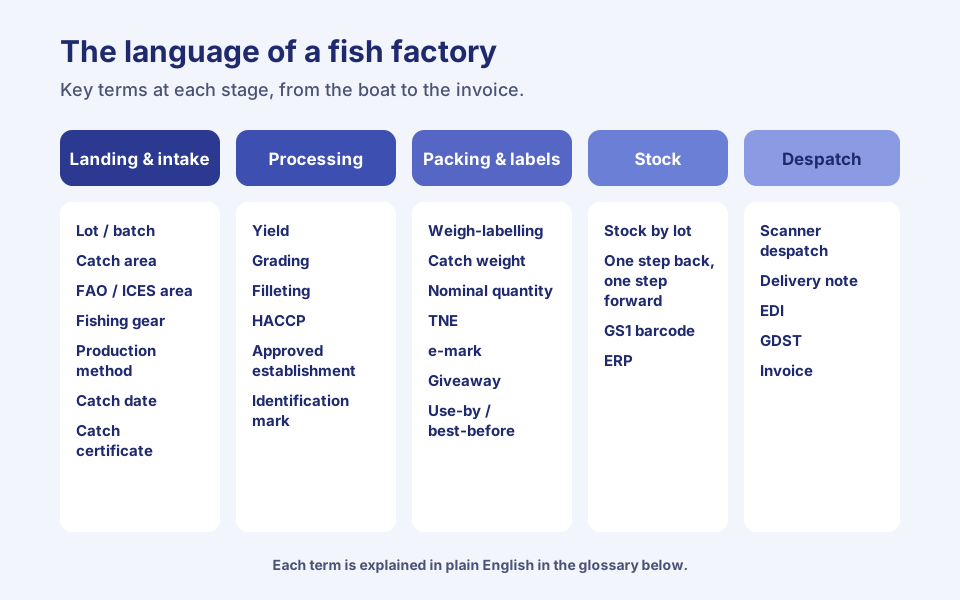
The short answer: this glossary explains 39 terms that come up every day in a UK fish business, grouped by topic: traceability and labelling, landing and first sale, exports, hygiene, weights and measures, production, and systems. Each definition is a plain-English summary of UK legislation and official guidance from the MMO and the Food Standards Agency. Use it to check a word you've met on a label, a sales note, an inspector's letter or a software demo, then follow the links for the detail.
Traceability and labelling
Traceability. Following fish from the vessel or farm to retail sale. Every food business must know who supplied it and which businesses it supplied: "one step back and one step forward", as the Food Standards Agency puts it. Fish lots may only be split or merged after first sale if you can still trace them back to the catch.
Lot. A quantity of fish of one species, in the same presentation, from the same catch area and the same vessel (or group of vessels) or farm. A labelled fish box or bag that fits that description is a lot, and it carries a lot number plus details such as the vessel, species, catch date and net weight.
Commercial designation and scientific name. The accepted common name for a species, such as Atlantic cod, and its Latin name, Gadus morhua. Consumer labels need both, and the Government publishes the list of names accepted in the UK.
FAO alpha-3 code. The three-letter species code used on landing records, sales notes and lot labels, such as COD for Atlantic cod or HAD for haddock. The MMO publishes the common ones.
Production method. One of three set phrases on consumer labels: "caught", "caught in freshwater" or "farmed".
Catch area. Where the fish was caught or farmed. For sea fish from the North-East Atlantic or the Mediterranean and Black Sea, consumer labels need the sub-area or division as a name, not just a code. Farmed fish need the country where they reached more than half their final weight or spent more than half their rearing period. Our UK fish labelling guide has examples.
FAO major fishing area. One of 27 areas the UN Food and Agriculture Organization uses for fishery statistics: 19 marine and 8 inland. UK waters are in area 27, the Atlantic Northeast, which is divided into subareas and divisions such as 27.4.b (Central North Sea) or 27.7.e (Western English Channel).
ICES area. The ICES statistical areas are the subareas and divisions of FAO area 27. So the ICES area the MMO asks for on lot labels is the same division that goes on the retail label, written as a code.
Fishing gear category. For wild-caught fish, consumer labels show one of seven categories: seines, trawls, gillnets and similar nets, surrounding and lift nets, hooks and lines, dredges, or pots and traps. Lot labels and catch certificates use the more detailed gear code, such as TBB for beam trawls or FPO for pots.
Defrosted. Fish that was frozen and is sold thawed must be labelled "defrosted". There are exceptions, including fish defrosted before smoking, salting, cooking, pickling or drying, and fish used as an ingredient.
Use-by and best-before. A use-by date is about safety: it replaces the best-before date on foods that are highly perishable from a microbiological point of view, and food past it is deemed unsafe. A best-before date (the "date of minimum durability") is about quality: the date until which the food keeps its properties when properly stored.
Landing and first sale
Landing. The first unloading of fish from a fishing vessel onto land. The master of a vessel 10 metres or longer must send a landing declaration within 48 hours, listing each species, its quantity and presentation, the catch area and the port of landing.
First sale and registered buyer. First-sale fish is fish from a fishing vessel that is offered for sale for the first time. To buy it direct from a vessel or its agent you must be a registered buyer, unless you buy under 30 kg a day for your own consumption or buy only at a designated auction site. Buying from a merchant or wholesaler is "second sale" and needs no registration.
Sales note. The record a registered buyer or seller completes and submits for each first-sale transaction. Records of each sale must be kept for three years, and sales notes go in electronically (e-Sales) where turnover is over £175,000.
Exports and IUU
IUU fishing. Illegal, unreported and unregulated fishing: fishing that breaks the law, catches that go unreported or misreported, and fishing against conservation rules.
Catch certificate. A document showing fish was caught legally, needed to export fish landed by UK vessels to the EU and some other countries. You create one per export on the MMO's Fish Export Service; since January 2026 it also asks for the trip start date, gear type and more detailed catch area.
Processing statement. A document linking processed products to their catch certificates. Since January 2026, UK-landed fish that is processed in the UK before export needs both a catch certificate and a processing statement. Filleting, smoking and cooking count as processing; freezing, washing or packing alone don't.
Hygiene and approvals
Approved establishment. Premises such as fish processing plants, auction halls and wholesale markets need approval from the competent authority, not just registration, before they can operate. In England and Wales you apply through your local authority.
Identification mark. The oval mark an approved establishment applies to the packaging or label of products of animal origin, including fish. In Great Britain it must include "UK", "GB" or "United Kingdom" and the establishment's approval number. Northern Ireland has its own format.
HACCP. Hazard Analysis and Critical Control Point, the principles every food safety management system must follow: identify hazards, find the points where they must be controlled, set limits, monitor them, put things right, check the system works and keep records.
Weights and measures
Net weight and glaze. Net weight is the weight of the food without its packaging, and it's the figure lot labels must show in kilograms. For glazed frozen fish, the declared net weight must not include the glaze (the layer of ice on the fish).
Average quantity system and nominal quantity. The rules for packs made up without the customer present and marked with a weight (the nominal quantity) between 5 g and 25 kg. There are three packers' rules: the batch must average at least the nominal quantity, only a small proportion of packs may be short by more than the tolerable negative error, and no pack may be short by more than twice it.
Tolerable negative error (TNE). The amount a pack may fall short of its nominal quantity under the average system, set out in a table in the regulations. For a 500 g pack it's 15 g. Our guide to reducing giveaway has the full table.
℮ mark. A small "e" that a packer can put on a pack to declare that the pack complies with the average system. It's optional, the UK still recognises it, and it may not be used on packs that don't meet the criteria.
Variable weight (catch weight). Goods priced and invoiced on their actual weight, which differs from one unit to the next, like a box of fish weighed at despatch. GS1 calls these variable measure trade items. Each delivery must weigh at least what's charged for: short weight is an offence under the Weights and Measures Act 1985.
Giveaway. Fish you pack beyond what the customer pays for or the pack declares. It isn't a legal term, just the safety margin packers add to stay clear of the weight rules.
Verified scale. Weighing equipment used in business must be passed as fit for use for trade by a weights and measures inspector or an approved verifier, and requalified after it's repaired or adjusted.
Production
Presentation. The form the fish is in, recorded with a three-letter code: WHL (whole), GUT (gutted), GUH (gutted and headed), FIL (filleted) or FIS (skinned fillets), among others. Presentation is part of what defines a lot.
Grading. Sorting fish by quality and size. The marketing standards set freshness categories (Extra, A and B) and size categories, by weight or number per kilogram, for species including cod, haddock, plaice and mackerel. Crabs, scallops and whelks are graded by shell width.
Filleting. Cutting fish into fillets. In the official presentation codes, FIL means headed, gutted, tailed and boned, giving two fillets from each fish.
Yield. The weight of finished product you get from the raw material, usually shown as a percentage, such as fillet weight against whole-fish weight. You can only measure it if weights are recorded at intake and after each stage.
Systems and data
Weigh-labelling. Weighing each box or pack and printing its label, with the real weight and traceability details, in one step, so nothing is handwritten or typed in twice.
Packing station. A workstation where boxes are weighed, labelled with a barcode and recorded into stock as they're packed.
Scanner despatch. Scanning each box's barcode as it's loaded, so the system can check every order is complete and on the right van before it leaves.
GS1 barcodes. Barcodes built to the GS1 standards, which can carry a product number (GTIN), batch or lot numbers and dates. A separate GS1 code, the SSCC, identifies a logistic unit such as a case or pallet.
EDI. Electronic data interchange: business documents sent directly from one computer system to another in a standard format. The most used are the order, the invoice and the despatch advice.
GDST. The Global Dialogue on Seafood Traceability, a non-profit foundation set up in 2017 that publishes a standard for sharing seafood traceability data digitally. It's voluntary: some buyers ask for it, but UK law doesn't.
ERP. Enterprise resource planning: one system that runs orders, stock, production, invoicing and accounts together.
Factory-floor system. Software that runs intake, weighing, grading, labelling, packing and despatch, and passes the data to a separate accounts package or ERP. Our guide to choosing fish processing software compares the options.
Where Aquarius fits
Aquarius Pro from ACSS covers many of these terms in one system built for UK fish businesses: catch details captured at goods in, weigh-labelling at packing stations with barcoded traceability labels, and optional modules for filleting, hand grading, scanner despatch and EDI. It links to Xero, Sage and QuickBooks. See how the Aquarius system works, or get in touch if you'd like to see it with your own products.
Quick answers
What's the difference between an FAO area and an ICES area? In the North-East Atlantic they describe the same waters: a box label code such as 27.7.e and a retail label's "Western English Channel" are the same place.
Do I have to use the ℮ mark? No. It's voluntary, but if you use it your packs must meet the average quantity system.
Do I need to be a registered buyer? Only if you buy first-sale fish direct from a vessel or its agent. Buying at a designated auction site, or from a merchant or wholesaler, doesn't need registration.
Is GDST a legal requirement in the UK? No. It's a voluntary data standard. The legal minimum is the traceability information set out by the MMO.
Sources
- Traceability and labelling information for fisheries products and Common species codes and names for fish landed in the UK (MMO, GOV.UK)
- Buyers and sellers of first-sale fish, FAO areas for the North East Atlantic and Processing, presentation and marketing information for fish (MMO, GOV.UK)
- Illegal, Unreported and Unregulated (IUU) fishing, Create a UK catch certificate, EU IUU Regulation changes 2026, Processing statement updates and Gear type codes (MMO, GOV.UK)
- Regulation 1379/2013: Article 35, Article 37, Article 38 and Annex III (legislation.gov.uk)
- Regulation 1224/2009: Article 4 (definitions of lot and landing), Article 23 (landing declaration) and Article 58 (traceability) (legislation.gov.uk)
- Regulation 178/2002, Article 18 and the FSA's Guidance on food traceability, withdrawals and recalls
- Regulation 1169/2011: Article 2, Article 24, Annex VI and Annex IX (legislation.gov.uk); Best before and use-by dates (FSA, GOV.UK)
- Regulation 853/2004: Article 4, Article 5 and Annex II; Regulation 852/2004, Article 5 (legislation.gov.uk)
- Approved food establishments, Guidance on health and identification marks and Food safety management systems (HACCP) (FSA)
- Regulation 2406/96: Article 6 and Article 7 (marketing standards, legislation.gov.uk)
- The Weights and Measures (Packaged Goods) Regulations 2006: regulation 2, regulation 4 and Schedule 3; Weights and Measures Act 1985, section 28 (legislation.gov.uk)
- Packaged goods: weights and measures regulations and Weights and measures: business guidance (GOV.UK)
- FAO major fishing areas (FAO CWP Handbook); ICES Statistical Areas (ICES)
- GS1 barcodes, SSCC, GS1 EDI and What is a variable measure trade item? (GS1)
- About the GDST (Global Dialogue on Seafood Traceability)
This glossary reflects the legislation and guidance published as of September 2026. It's a practical summary, not legal advice. If you're unsure how a rule applies to your business, check with the MMO, your local authority or trading standards.