
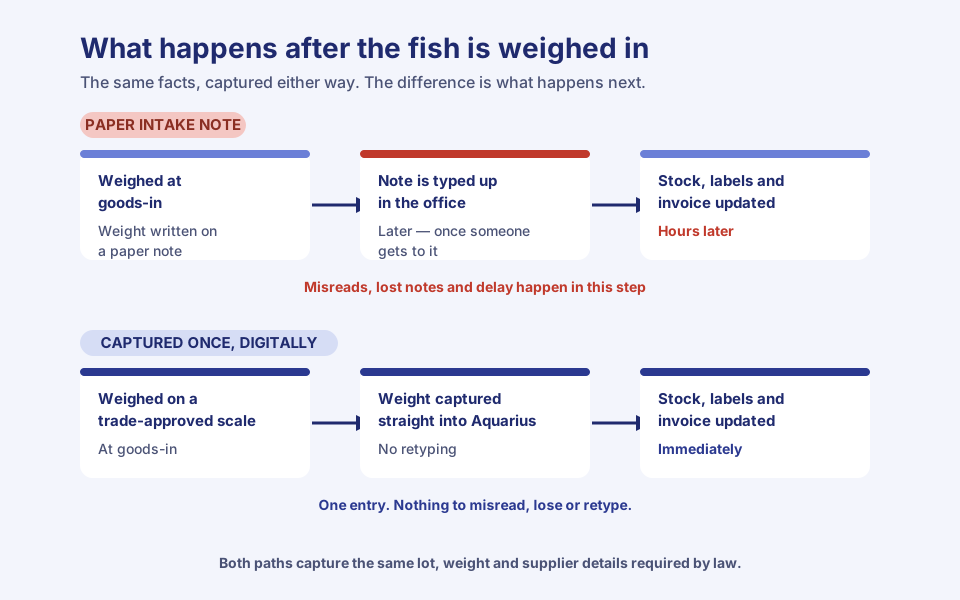
The short answer: a paper intake note can satisfy the letter of the law — the catch data is written down somewhere. The cost isn't the form. It's what happens next: someone has to read the handwriting, type it into a spreadsheet or accounts package, and hope the weight, the lot number and the supplier name all survive the trip. Every one of those re-keying steps is a chance for an error, a delay before anyone can see what's actually in stock, and extra minutes when a customer, an auditor or a trading standards officer asks you to trace a batch. Capturing the same information once, at the scale, removes the second pass and the errors that come with it.
What the law actually requires at intake
Strip away the paperwork habits and the legal minimum is fairly short. Under Article 18 of the retained version of Regulation (EC) 178/2002, a food business has to be able to identify who supplied it with food, and to have "systems and procedures" that make that information available to the enforcement authorities "on demand" — the Act doesn't set a deadline, just a duty to be able to produce it when asked.
For fish specifically, GOV.UK's guidance for the Marine Management Organisation sets out the minimum data that has to travel with each lot from first sale onward: a lot identification number, the vessel or aquaculture unit, the species, the catch date, the net weight, the supplier's name and address, the catch area, the production method, the gear category, and whether it's been previously frozen. The guidance is explicit that this information "must always be accessible by fisheries authorities" — it has to exist and be retrievable, not necessarily be digital.
None of that requires software. A legible paper note that captures those fields, filed somewhere you can find it again, technically does the job. The question worth asking isn't whether paper is legal — it is — but what it costs you between the goods-in door and the point where that information is actually useful.
Where the real cost sits: the second pass
Almost every fish business we've spoken to that still runs intake on paper does the same thing twice: once at goods-in, with a pen, and again in the office, typed into a spreadsheet, a stock sheet or the accounts package. That second pass is where the cost lives, not the first:
- Handwriting gets misread. A weight of 18.5 kg becomes 185 kg, or a lot number gets a digit transposed. Nobody notices until a label is wrong, an invoice is queried, or a yield report doesn't add up.
- Nothing is visible until someone types it up. Stock, cost and traceability all lag behind the fish itself by however long the note sits in a tray before someone gets to it — an hour, a shift, sometimes longer at a busy intake.
- The note itself can go missing. Wet hands, ice, and a goods-in area that gets hosed down daily are not kind to a sheet of paper. One of our customers, Enterfoods in Fraserburgh, told us that before they moved onto Aquarius they relied on handwritten intake notes; since switching, intake information is available as soon as the product is booked in, and the label printed at intake follows the fish through the rest of the factory.
- It has to be found again, by hand. If a customer queries a batch, or an inspector asks to trace a lot, someone has to go back through notebooks or filed sheets to find the right one. The law's "on demand" duty doesn't name a number of minutes, but being visibly slow in front of an inspector, or taking a day to answer a customer complaint about a specific batch, is its own kind of damage.
How seriously regulators take the records themselves
Paper traceability records aren't treated as a formality. In the Food Standards Agency's 2025 audit of how local authorities in England handle shellfish registration documents (SRDs) — the paper record that travels with shellfish from harvester to first buyer — all the SRDs checked could be traced back to the harvester, and the Food Law Code of Practice requires local authorities to keep those records for at least 12 months. The audit's main criticism wasn't that paper failed, but that routine monitoring of the paper trail was patchy: only three of the eight local authorities checked had an effective system for monitoring their own SRD records. That's a useful illustration of the pattern: paper can carry the right information, but keeping it consistently checked, filed and quickly searchable takes more discipline than most businesses have time for.
A quick way to tell if paper is costing you
Ask these about your current intake process:
- If a customer phoned about a specific delivery from three weeks ago, how long would it take to find that intake note and read off the lot number?
- How many people touch a weight between the scale and the invoice — and how many times is it copied by hand?
- If the goods-in book got wet or went missing for a day, would anyone notice before they needed it?
- Does anyone know today's intake weight by species, or only once the day's notes are typed up?
If any of those answers make you wince, the paper itself isn't the problem — the gap between when the information is created and when it's usable is.
Where Aquarius helps
Aquarius's goods-in module captures intake the same way the rest of the factory works: weighed on a trade-approved scale — including floor scales for a whole trolley at once — with the weight going straight into Aquarius rather than onto a sheet of paper. That same intake record carries the lot number, supplier, species and catch details through to the label, the stock figures and the invoice, so nobody retypes a weight later, and the information an inspector or a customer might ask for is a scan or a search away rather than a trip to the filing tray. Aquarius also includes food safety checklists, such as temperature checks at intake, recorded in the same system as the stock and traceability data. It's the goods-in half of the Aquarius system that runs from goods in to despatch; see how the labelling and traceability works for what that record becomes further down the line. If your intake still runs on paper and a typed-up copy, we're happy to show you what the alternative looks like.
Quick answers
Is a paper intake note illegal? No. The law requires you to be able to identify your supplier and produce that information to enforcement authorities on demand; it doesn't dictate paper or digital. The cost of paper is operational, not legal.
What has to be recorded when fish comes in? At minimum: a lot identification number, the vessel or aquaculture unit, species, catch date, net weight, the supplier's name and address, the catch area, the production method, the gear category, and whether it's been previously frozen.
How long do intake records need to be kept? General guidance leaves the exact period up to the business, as long as records are available while the food could reasonably still be in the supply chain. For shellfish registration documents specifically, the Food Law Code of Practice requires local authorities to keep them for at least 12 months.
How fast do I need to be able to trace a batch? The law says "on demand" without naming a deadline. In practice, how long it actually takes you to put your hands on the right record is a fair measure of how exposed you are, whatever the paperwork technically allows.
Does switching off paper mean more typing somewhere else? Not if the weight is captured once, at the scale, and that same record carries through to labels, stock and invoicing rather than being retyped at each step.
Sources
- Regulation (EC) 178/2002, Article 18 (Traceability) (legislation.gov.uk, as retained in UK law)
- Traceability and labelling information for fisheries products (GOV.UK / Marine Management Organisation)
- Local authority shellfish traceability audit: summary report, England, July 2025 (Food Standards Agency)
This is a practical summary, not legal advice. If you're unsure what your intake records need to cover, check with your local trading standards or environmental health service.