
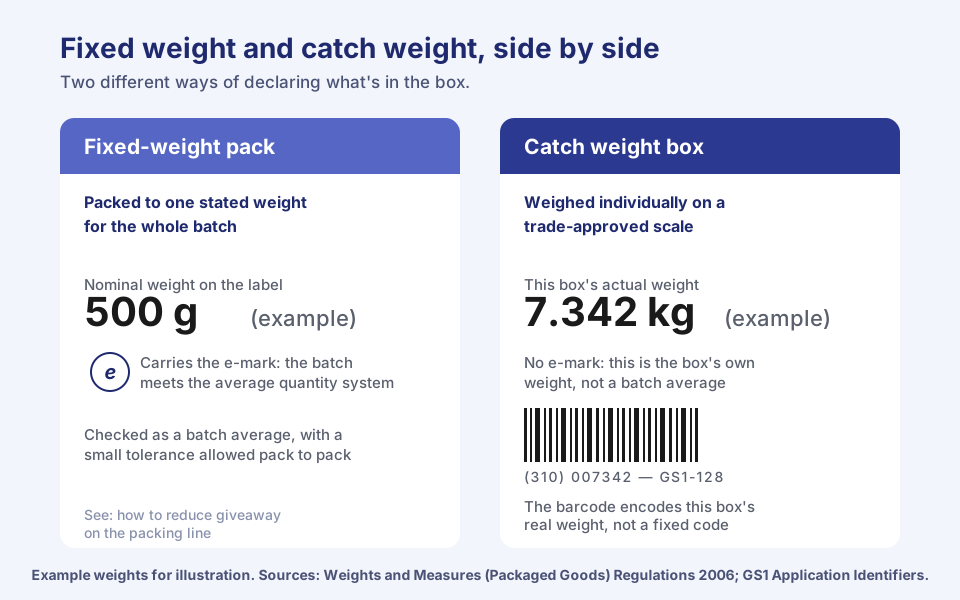
The short answer: catch weight is the actual weight of an individual box or pack, not a weight fixed in advance, and most boxes of whole or filleted fish are sold this way because nobody can fix the exact weight before the fish is cut and weighed. That weight has to come off a legal-for-trade ("trade-approved") scale, because it's what the customer is charged for. A catch weight box doesn't carry the small e-mark (the "estimated sign") seen on fixed-weight retail packs — that mark is a voluntary declaration for a different system, batches packed to one stated nominal weight, not boxes that each state their own true weight. If the box carries a barcode, a GS1-128 barcode can encode that exact weight in the barcode itself, so anyone who scans it further down the chain reads the real figure off the scale, not a number someone typed in.
What does "catch weight" actually mean?
Most packaged goods on a supermarket shelf are packed to a stated weight: a bag of frozen peas says "1 kg" and every bag in the batch is meant to come out close to that figure. That's a fixed, or nominal, weight.
Catch weight is the opposite. A box of whole cod, a tray of fillets, a crate of langoustines — nobody decides in advance exactly how much it will weigh. Each one is weighed as it's packed, and that actual figure, whatever it comes to, is what goes on the label and the invoice, usually at a price per kilo. The name comes from the weight you "catch" on the scale, not from the fish itself, though in a fish business the two meanings sit nicely together.
Because the customer is charged for the actual weight on the box, this is covered by the ordinary short-weight protection in the Weights and Measures Act 1985: section 28 makes it an offence to deliver less than what's charged for. There's no averaging and no tolerance band — every box has to be at least what the label and the invoice say. That's a different rule from the one that applies to fixed-weight retail packs, which we covered in how to reduce giveaway on the packing line: that post is about packing to a stated weight without overshooting it; this one is about correctly declaring whatever weight you actually packed.
Does a catch weight box need the e-mark?
No, and it's worth knowing why, because it's easy to assume every weight declaration needs some kind of official mark.
The e-mark — a stylised lower-case "e" next to a weight, officially called the estimated sign — is defined in the Weights and Measures (Packaged Goods) Regulations 2006. It's a packer's voluntary declaration that a batch of goods, each packed to one stated nominal quantity, complies with the regulations' "average quantity system": the system where the batch average has to meet the stated weight, with only a small, defined proportion of packs allowed to fall a little short. Using the mark lets those packages move through trade in other markets without being re-checked. It's not a general stamp of honesty on any weight you print.
It's also tightly controlled. Only the packer, the importer or their authorised representative may apply it, and marking a package with it — or anything that could be mistaken for it — when you're not entitled to is a specific offence. Anyone packing and exporting E-marked goods also has to notify their local weights and measures authority.
None of that applies to a catch weight box, because there's no batch average to declare: each box carries its own true weight, not an estimate against a stated nominal figure. Putting the e-mark next to it would be the wrong signal — it would suggest the weight is an average-quantity-system declaration when it's actually a direct, individually-weighed figure. The protection on a catch weight box comes from the scale it was weighed on, not from a mark on the label.
What makes a scale "trade-approved"?
Two separate things have to be true, and people sometimes only know about one of them.
The instrument itself has to be of a certified type. Under the Non-automatic Weighing Instruments Regulations 2016, a weighing instrument used for trade must carry the UK marking and the "M" marking (in Northern Ireland, the EU's CE marking still applies under the Windsor Framework arrangements), showing the model has been assessed as meeting the legal requirements for accuracy and construction.
That specific scale then has to be verified. GOV.UK's guidance is direct about this: "weighing and measuring equipment used in business must be passed as fit for use for trade by a Weights and Measures Inspector or an approved verifier." A scale doesn't become legal for trade just by being an approved model off the shelf — the individual unit has to be checked and stamped before it's used to charge anyone. If it's later repaired or adjusted, it has to be requalified by an inspector or approved verifier before it goes back into use.
In practice that means two checks when you're buying scales for a weigh-label station: is this model type-approved, and will the supplier get the actual unit verified once it's installed? A scale that's only the first of those isn't legal for trade yet.
How a GS1-128 barcode carries a catch weight
A fixed barcode works fine for a fixed-weight product: the same code on every tin of the same soup always means the same thing, and the till looks up the price. That doesn't work for catch weight, because every box is a different weight.
GS1-128 is a barcode format built for exactly this: instead of a single fixed number, it strings together several pieces of data, each tagged with an Application Identifier (AI) that says what the following digits mean. There's a defined set of AIs in the 310-series for product net weight in kilograms, so a box's actual weight — whatever the scale read — can be encoded directly into the barcode alongside the product, batch and dates, rather than being a separate figure someone has to key in by hand. Scan the barcode anywhere down the chain — at despatch, at a customer's goods-in desk — and the weight that comes back is the one the scale recorded, not one retyped from a delivery note.
Where this fits on a weigh-label station
ACSS supplies the scales that this depends on: trade-approved Dini Argeo scales, with bench scales at each weigh-label station and floor scales for weighing whole trolleys at intake or before despatch (we don't run conveyor-line scales). Labels printed from those weights can carry GS1-128 barcodes alongside the traceability details, so the actual weight a box was packed at travels with it electronically, not just on paper. See the full line-up on fish factory hardware, or how it all comes together on the Aquarius system. If you're still weighing on one scale and typing the figure into a label template on another screen, we're happy to show you what a weigh-label station looks like.
Quick answers
Is catch weight the same thing as giveaway? No. Giveaway is extra weight added on top of a stated target, usually on fixed-weight packs. Catch weight is a box whose own actual weight, whatever it is, is what's charged and labelled — there's no target to overshoot.
Does a catch weight box need the e-mark? No. The e-mark declares that a batch of fixed-nominal-weight packs meets the average quantity system. A catch weight box states its own actual weight rather than an average against a stated figure, so the mark doesn't apply.
Do my scales have to be officially verified, or is a certified model enough? Both are needed. The model has to carry the UK and M marking under the Non-automatic Weighing Instruments Regulations 2016, and the individual scale then has to be passed as fit for use for trade by an inspector or approved verifier before it's used to charge anyone.
Can two boxes of the same product really carry different weights in the same type of barcode? Yes. A GS1-128 barcode's net-weight Application Identifier is built to carry a different value on every box — that's the point of it, as opposed to a fixed barcode that always means the same thing.
What happens if a trade scale is repaired? It has to be requalified — checked and stamped again as fit for use for trade — by an inspector or an approved verifier before it goes back into service.
Sources
- The Weights and Measures Act 1985, section 28: short weight, etc. (legislation.gov.uk)
- The Weights and Measures (Packaged Goods) Regulations 2006, specifically regulation 11 (notices to local authorities), regulation 15 (offences relating to E-marks) and Schedule 4 (the E-mark) (legislation.gov.uk)
- The Non-automatic Weighing Instruments Regulations 2016, specifically regulation 43 (conformity indicated by the UK marking and the M marking) (legislation.gov.uk)
- Weights and measures: business guidance (GOV.UK) — verification of weighing equipment used for trade
- GS1 Application Identifiers reference — the 310-series Application Identifiers for product net weight in kilograms
This is a practical summary, not legal advice. If you're unsure how these rules apply to a specific product line, check with your local trading standards service.