

The short answer: fillet yield is the weight of usable fillet you get back from a whole fish, as a percentage: fillet weight divided by whole-fish weight, times 100. Seafish's own training data puts cod, haddock and plaice fillets at around 50% of whole weight (skin-on), with other species and cuts ranging from the low 20s to the high 60s — the cut, the size of fish and whether skin is left on all change the number, so two "yield" figures are only comparable if they're measured the same way. You improve it not by chasing a published percentage, but by weighing in and out consistently, measuring your own yield rather than assuming it, and tracking it over time so a drift gets caught before it costs you a season's margin.
What "fillet yield" actually means
Fillet yield is simple arithmetic: the weight of the fillet (or steak, or suprême, or whatever the final cut is) divided by the weight of the whole fish you started with, expressed as a percentage.
Yield % = (weight of finished product ÷ weight of whole fish) × 100
The hard part isn't the sum. It's that "yield" means nothing on its own without saying what you're comparing against. A 50% yield on skin-on fillets from round whole fish is a different number from a 50% yield on skinless fillets from fish that were already headed and gutted before you weighed them in. Before you compare your yield to anyone else's — another factory, a buyer's expectation, a number you read somewhere — check that both sides mean the same starting weight, the same finished cut, and skin-on versus skinless.
What typical yields actually look like
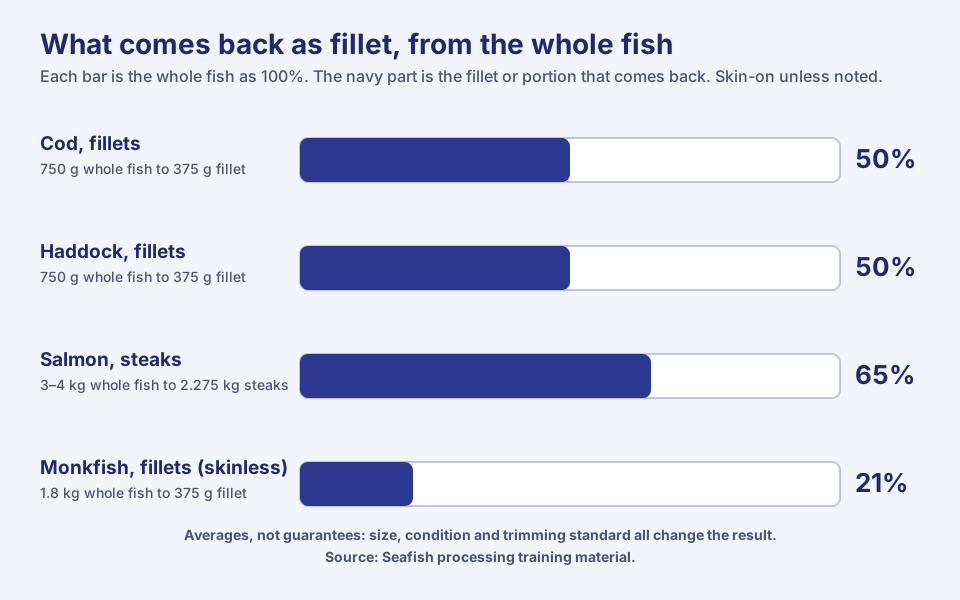
Seafish, the UK seafood industry's own authority, publishes a yields table as part of its processing training material, giving the average yield by species and cut, based on skin-on product unless stated. A few examples from that table:
| Species | Cut | Whole fish | Fillet/portion weight | Yield |
|---|---|---|---|---|
| Cod | Fillets | 750 g | 375 g | 50% |
| Haddock | Fillets | 750 g | 375 g | 50% |
| Plaice | Fillets | 750 g | 375 g | 50% |
| Lemon sole | Fillets | 650 g | 375 g | 57% |
| Salmon | Steaks | 3–4 kg | 2.275 kg | 65% |
| Salmon | Suprêmes | 3–4 kg | 2.03 kg | 58% |
| Cod | Suprêmes | 4–6 kg | 1.5 kg | 30% |
| Monkfish | Fillets (skinless) | 1.8 kg | 375 g | 21% |
Two things stand out. First, the same species gives wildly different yields depending on the cut: cod comes out at 50% as a simple fillet but only 30% as a boned, portioned suprême, because more of the fish is trimmed away to get there. Second, monkfish — sold skinless and with a large head relative to body weight — yields barely a fifth of the whole fish as fillet, which is a normal, expected figure for that species rather than a sign something's wrong. Seafish's table notes that skinless portions generally yield around 10% less than the skin-on figure for the same cut.
None of this is a target to hit. It's a reference point for what's typical, so you can tell whether your own numbers are in a sensible range for the cut you're actually making.
How to work out your own yield
The only reliable way to know your yield is to measure it, on your own fish, on your own line:
- Weigh the whole fish (or batch) in, before any processing, on a scale you trust.
- Weigh the finished product out — the same batch, the same cut, once trimming and portioning is done.
- Divide and record it, against the species, cut, and ideally the size grade of fish that went in.
- Do it often enough to see a pattern, not just once. A single day's figure can be thrown off by one unusually large or small fish, a quiet moment where staff rush, or a cutter having an off day.
Comparing your result to a published table like Seafish's tells you whether you're in a plausible range. Comparing it to your own factory's history over time tells you whether something has actually changed — a new batch of fish, a new cutter, a blunter knife, a different supplier — and that second comparison is the one that actually helps you manage the business.
Where the yield usually goes astray
None of the following is a guaranteed fix, because yield depends on the fish as much as the factory. But these are the places worth checking first when a yield figure looks worse than it used to:
- The basis has quietly changed. If fish are coming in at a different stage (round versus headed and gutted) or a different average size than before, last month's yield figure isn't a fair comparison any more, even if nothing on the cutting line has changed.
- Trimming standard varies by person. Over-trimming to be safe on quality lowers fillet yield; under-trimming raises it but can create a quality or customer complaint later. A consistent standard, checked occasionally, keeps the trade-off deliberate rather than accidental.
- Scales drift or aren't checked often enough. If the weight going in or the weight coming out isn't accurate, your "yield" is measuring scale error as much as anything that happened on the line. The same discipline that matters for legal-for-trade weighing and giveaway applies here.
- Nobody's actually looking at the number regularly. A yield that's tracked once a quarter, from a spreadsheet someone has to go and build, gets noticed and acted on far more slowly than one that shows up the same day production happens.
Where Aquarius helps
Aquarius's factory processing includes a filleting module, and its packing stations are built to capture yield as the work happens rather than after the fact — the system records what came in and what went out as part of the same process that weighs, labels and invoices the finished product. That turns yield from a figure someone calculates occasionally into something you can see by species, cut or shift as it happens, which is what actually lets you catch a drift early rather than at stocktake. It's one part of the wider factory processing system, alongside the packing stations that weigh and label the finished product. If you're currently working out yield by hand, or not at all, we're happy to show you what that looks like day to day.
Quick answers
What's a good fillet yield for cod or haddock? Seafish's training data puts a standard skin-on fillet at around 50% of whole-fish weight for both. More heavily trimmed or boned cuts, like suprêmes, yield less from the same fish because more is removed to get there.
Does yield include the skin? Only if the finished product is skin-on. Seafish's figures are skin-on unless stated, and note that skinless portions yield roughly 10% less than the skin-on figure for the same cut.
Why do two factories get different yield numbers for what looks like the same product? Almost always because the basis differs: whole round weight versus headed-and-gutted weight going in, or a slightly different finished cut coming out. A yield percentage is only meaningful alongside a clear statement of both.
Does a lower yield mean something's wrong? Not necessarily. Species, size of fish, and the cut you're making all change the expected number — monkfish fillets yield a fraction of what a simple cod fillet does, and that's normal for the species, not a processing fault.
Do I need special software to track yield? No, a notebook and consistent weighing will do it. Software helps mainly by capturing the weigh-in and weigh-out automatically as part of work that's happening anyway, so the figure is there every day rather than something someone has to build from scratch.
Sources
- Yields (Seafish processing training material) — average yield by species, cut and whole-fish weight, skin-on unless stated