
The short answer: ordinary scales and printers fail fast in a fish factory because of the combination nobody else deals with: near-freezing rooms, salt from ice and brine, and a hosing-down with hot water and chemicals, often more than once a day. Buy for IP69K, the rating that's actually tested against a close-range, high-pressure, high-temperature jet, not just "waterproof" on a brochure. Look for 316-grade (or equivalent) stainless steel on anything that touches fish, ice or cleaning chemicals, because ordinary 304 stainless corrodes faster in salt. And if the scale is used to charge a customer, UK law requires its printer to produce a legible, durable printout — so a printer that fades or jams in the damp isn't only a nuisance, it's a compliance problem.
Why a fish factory is harder on equipment than most factories
Most industrial kit is designed for one of these at a time: cold storage, a wet environment, or regular washdown. A fish factory usually has all three running at once. Processing rooms sit a few degrees above freezing, ice and brine put salt into the air and onto every surface, and because you're handling food, the floor, benches and equipment get hosed down with hot water and cleaning chemicals, often more than once a day.
None of that is unusual for the industry — it's just what keeping fish cold and the factory clean requires. The problem is equipment built to a general industrial spec, rather than this specific combination, which corrodes, shorts out or stops reading reliably within a year or two, usually starting with whichever cable, connector or seam the manufacturer didn't think to protect.
What "IP69K" actually promises
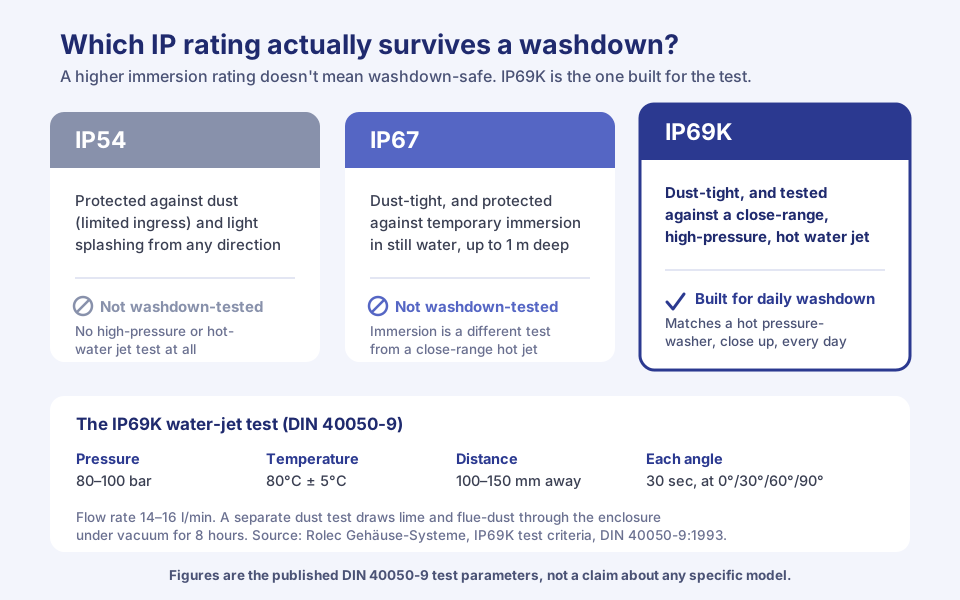
The IP (Ingress Protection) code on a datasheet is two digits: the first is protection against solid objects and dust, the second against water. A rating of IP6X means dust-tight — no dust gets in at all. That part is straightforward.
The water digit is where people get caught out. The scale most engineers know, defined in IEC 60529, runs from light splashing up to temporary or continuous immersion (IPX7 and IPX8). None of those steps is a washdown test — a device rated IP68 for immersion can still fail the first time someone points a hot pressure washer at it from close range, because that's a different kind of stress.
That's what IP69K was created for, under the German standard DIN 40050-9 (the "K" originally stood for Kraftfahrzeug, German for motor vehicle, since it was developed for vehicles that get steam-cleaned). The test sprays the enclosure with a fan nozzle from 100–150 mm away, at 80–100 bar and 80°C ± 5°C, at 14–16 litres a minute, from four angles — 0°, 30°, 60° and 90° — for 30 seconds each, on a slowly rotating turntable, alongside a separate dust test that draws a 50% lime powder, 50% flue dust mixture through the enclosure under vacuum for 8 hours. In plain terms, IP69K is tested against exactly the kind of hot, close-range, high-pressure hose-down a fish factory does every day. IP68 is not.
Two things are worth checking before taking any of this on trust. Ask for the rating of the exact model, not the product family — suppliers sometimes rate the load cell to IP69K while the display or cable glands are rated lower, and the assembly is only as protected as its weakest part. And IP69K says nothing about chemicals: the test uses hot water only, so a unit still needs materials that resist the detergents your factory actually uses.
Why the steel matters as much as the IP rating
Stainless steel resists rust because chromium in the alloy forms a thin, self-healing oxide layer. Chloride — from salt, brine, seawater and some cleaning chemicals — attacks that layer and can cause pitting, especially in the crevices around welds, fasteners and seals. That's the main reason "stainless" equipment in a fish factory can still rust.
The usual fix is molybdenum. Grade 316 stainless adds roughly 2–3% molybdenum over grade 304, and manufacturer corrosion-resistance data consistently ranks 316-family grades above 304 for resistance to pitting and crevice corrosion in chloride-containing environments — Aperam's own datasheet for its 316A grade describes "improved resistance to corrosion in acids and chloride-containing media, as well as to pitting, crevice, and intergranular corrosion" compared with 304. That's why 316 (or an equivalent food-contact grade) is the usual choice for anything that sits where fish, ice, brine or washdown chemicals reach it, while cheaper 304 is more often kept for dry areas. It's not only about the enclosure, either: cables, connectors and fixings need the same chloride resistance as the panel they're bolted to, or you've just moved the weak point rather than removed it.
What food hygiene law expects of the equipment itself
This isn't only a durability question; it's also what the law expects of equipment that touches food. Regulation (EC) No 852/2004 on the hygiene of foodstuffs, which still applies in UK law, sets out in Annex II that surfaces in contact with food must be "sound, easy to clean and, where necessary, to disinfect," requiring "smooth, washable, corrosion-resistant and non-toxic materials, unless food business operators can satisfy the competent authority that other materials used are appropriate," and that equipment must be "installed in such a manner as to allow adequate cleaning of the equipment and the surrounding area." An IP69K-rated, 316-stainless scale or printer isn't just more robust — it's the practical way a supplier meets that standard in a wet, washed-down room, rather than something you only discover matters when an inspector asks about it.
Why your printer's durability is a legal question too
If the scale is used to charge a customer, the printer attached to it isn't just office equipment. The Non-automatic Weighing Instruments Regulations 2016 set out the conditions a scale must meet to be used for trade, and Schedule 4 deals with instruments fitted with a printing device directly: "a person must not use the instrument for trade unless the printing device produces a legible and durable printout." We covered the wider rules on trade-approved scales themselves in catch weight labelling for seafood packers.
In a wet, cold factory, "legible and durable" is exactly where a weak printer fails first: damp thermal labels that fade or smear, or print heads that jam when condensation gets into the mechanism. A printer that's physically protected from that environment isn't a nicety — on a trade scale, it's part of staying on the right side of the regulation.
A short buying checklist
- Ask for the test certificate for the exact model and enclosure, not a brochure line that just says "IP69K" or "waterproof."
- Check what's actually rated. The load cell, display, cable glands and printer housing can all have different ratings — the assembly is only as good as the weakest one.
- Look for 316 (or an equivalent food-contact grade) on anything that touches fish, ice, brine or cleaning chemicals, not just a generic "stainless steel" description.
- Protect the printer separately if it isn't itself washdown-rated, by housing it in a sealed enclosure rather than leaving it exposed on the bench.
- Match the cables and connectors to the same protection level as the main housing.
- Confirm the scale is both type-approved and individually verified for trade use before it's used to charge anyone.
How ACSS equips a weigh-label station
ACSS supplies the scales and printers that run with Aquarius, built to this brief: trade-approved Dini Argeo scales, with bench scales at each weigh-label station and floor scales for weighing whole trolleys at intake or before despatch, and Honeywell industrial label printers housed inside the same stainless steel enclosure to keep them clean and dry. The workstations use industrial-grade components with 316-grade stainless steel enclosures and are designed for IP69K ingress protection, with cables and connectors chosen to resist water and cleaning chemicals. See the full line-up on fish factory hardware, or how it fits into the wider system on Aquarius. If your current scales or printers are on their second or third repair this year, we're happy to show you what's changed.
Quick answers
Is IP68 enough for a fish factory? Not on its own. IP68 covers immersion, a different test from a washdown. For equipment that gets hosed down rather than submerged, IP69K is the rating that actually matches the risk.
Does the stainless steel grade matter if the IP rating is already high? Yes. The IP rating keeps water and dust out of the electronics; the steel grade is about whether the case itself corrodes. In a salty, washed-down room, 316 (or an equivalent food-contact grade) resists chloride pitting far better than ordinary 304.
Do I legally need my scale's printer to produce a durable printout? Yes, if the scale is used for trade. Schedule 4 of the Non-automatic Weighing Instruments Regulations 2016 says an instrument fitted with a printer must not be used for trade unless the printout is legible and durable.
What should I ask a supplier before buying? For the IP test certificate of the exact model, which parts of the assembly it covers, and the stainless steel grade used anywhere fish, ice, brine or cleaning chemicals reach.
This is a practical summary, not legal advice. If you're unsure how these rules apply to a specific product line, check with your local trading standards service.
Sources
- The Non-automatic Weighing Instruments Regulations 2016, Schedule 4 (legislation.gov.uk) — paragraph 5, printing devices
- The Non-automatic Weighing Instruments Regulations 2016, regulation 43 (legislation.gov.uk) — conformity marking
- Regulation (EC) No 852/2004 on the hygiene of foodstuffs, Annex II (legislation.gov.uk) — equipment and surface requirements
- Weights and measures: business guidance (GOV.UK)
- Rolec Gehäuse-Systeme GmbH, Information concerning system of protection IP69K — test criteria under DIN 40050-9:1993
- Aperam Stainless Europe, 316A technical datasheet — corrosion resistance compared with grade 304