
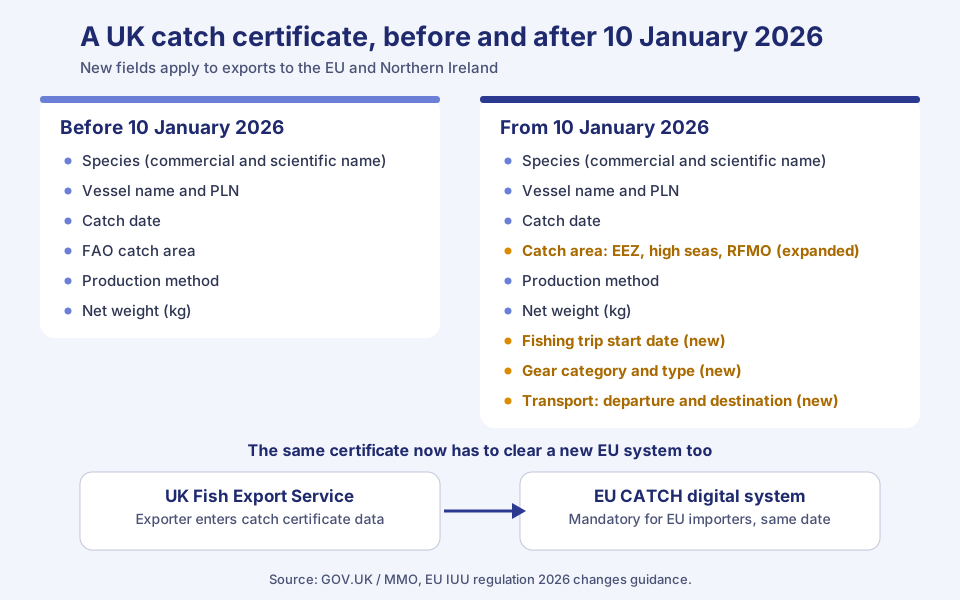
The short answer: since 10 January 2026, a UK catch certificate for exports to the EU (and Northern Ireland) needs three things it didn't need before: the fishing trip's start date, the gear category and type, and the catch area broken down by exclusive economic zone, high seas and any Regional Fisheries Management Organisation. On top of that, a processing statement is now needed for far more exports — including fish that was landed and processed in the UK, which previously needed only the catch certificate. The old Storage Document has been renamed the Non-Manipulation Document. None of this is part of the separate UK-EU SPS agreement still being negotiated, which is aimed at export health certificates and border checks, not catch certificates.
Why this is worth getting right
More than three-quarters of the catch landed by UK commercial fishing vessels is exported to the EU, according to the Marine Management Organisation (MMO). A catch certificate is required for every one of those export consignments, and the MMO has been blunt about what a mistake costs: "an omission of required information or a mistake in reporting at any stage of the journey" can block the certificate the export depends on. Its own guidance puts it even more plainly: if a business isn't ready, it won't be able to export seafood from the UK.
What's new on the catch certificate itself
The certificate you already use through the Fish Export Service hasn't been replaced — it now asks for more:
| Field | What's required |
|---|---|
| Fishing trip start date | The date the vessel left port on the trip that caught the fish. For store pots, it's when the vessel left port to collect them, not when they were originally deployed. |
| Gear category and type | Selected from a standard FAO list, rather than left off. |
| Catch area | The exclusive economic zone (EEZ) the catch came from, whether it was taken on the high seas, and whether the species and area fall under a Regional Fisheries Management Organisation (RFMO). This replaces simply stating the FAO area. |
| Transport | The first leg of transport from the point of export (port or place of departure, and means of transport), plus the point of destination. If the destination isn't yet known, the first point of entry into the EU can be used instead. |
Processing statements: the part that catches people out
Before January 2026, a processing statement was only needed for fish that had been imported and was being re-exported. That's widened. If a UK vessel lands fish in the UK and it's then processed — cutting, filleting, canning, smoking, salting, cooking, pickling or drying all count; freezing, washing or packing on their own don't — before being exported, you now need a processing statement as well as the catch certificate, and the statement has to reference that catch certificate.
A few details worth knowing before you fill one in:
- The catch certificate's declared weight should match the weight, state and presentation of what the vessel actually landed — it doesn't have to be the whole landing if only part of it is being exported.
- Each processing plant, and each separate instance of processing, needs its own statement.
- Processing that happens before the fish is landed — at sea, for example — doesn't need a processing statement.
The Storage Document is now the Non-Manipulation Document
From 10 January 2026 the UK Storage Document was renamed the Non-Manipulation Document (NMD). It still does the same job — confirming that stored product hasn't been altered — just under a new name on EU paperwork.
It connects to a new system on the EU side too
The same date, 10 January 2026, is when the EU's own import side changed. The MMO's guidance for exporters is direct about it: "EU importers will be legally required to use the EU CATCH digital system under the same timeframe." In practice, the data you enter into the Fish Export Service now has to be complete and correct enough to carry through into that EU system when your consignment arrives — there's no separate paper fallback if a field is missing.
This is separate from the UK-EU SPS deal
It's easy to conflate this with the wider UK-EU reset. They're not the same thing, and the MMO's own guidance says so explicitly: these catch certificate and processing statement changes are separate from the EU Reset negotiations.
The UK and EU agreed in May 2025 to negotiate a Sanitary and Phytosanitary (SPS) agreement. Defra's own fish and shellfish guidance on the agreement is direct about what it will and won't change: it "will remove the requirements for export health certificates (EHCs)" and most routine border controls, but "catch documentation for wild caught seafood will still be required for export to the EU. This includes a catch certificate, processing statement and non-manipulation document where relevant." IUU requirements aren't covered by the SPS agreement at all. And it isn't in place yet: the government's ambition is to conclude negotiations "by early 2027", but Seafish notes that's "not a fixed deadline", and Defra has given an implementation timescale of mid-2027. Until then, "all current arrangements remain in place."
In short: don't wait for the SPS deal to sort out your catch certificates. It's a different document, on a different track, and even once it lands it isn't expected to touch catch certification.
What to check now
- Does your intake record capture gear type and trip start date, not just catch date and area? Many businesses already record vessel, catch date and catch area at goods-in; gear and trip start date are newer asks and are easy to miss if nobody's added a field for them.
- Do you know which of your exports now need a processing statement? If you land UK fish and process it yourself before export, check this applies to you even if it never did before.
- Is everyone in your supply chain passing the right information down? The MMO is clear that fishers are the first link — a gap at first sale becomes a blocked certificate at export.
Where Aquarius helps
Aquarius's goods-in module already captures the vessel, catch date and catch area for each lot when it's weighed in, and carries that record through to the label and the stock figures rather than leaving it to be re-keyed later. Having that information reliably captured at intake, instead of chased up afterwards, is the groundwork that makes filling in the extra catch certificate fields far less painful. See how it works on labelling and traceability and goods in to despatch. If you're still piecing catch details together after the fact, we're happy to show you what the alternative looks like.
Quick answers
Is this a new document, or the same catch certificate with more fields? The same catch certificate, created the same way through the Fish Export Service. It just requires more information than it did before 10 January 2026.
Does this affect fish I only sell in the UK? No. Catch certificates are only needed for exports — to the EU, Northern Ireland, and a short list of other countries the MMO publishes guidance for.
What happened to the Storage Document? It was renamed the Non-Manipulation Document from 10 January 2026. It still confirms stored product hasn't been altered; only the name changed.
Will the UK-EU SPS agreement get rid of catch certificates? No. Defra's own guidance says catch documentation — catch certificates, processing statements and non-manipulation documents — will still be required for wild-caught seafood exports to the EU. The agreement removes export health certificates and routine border checks, not catch certification, and it isn't in force yet.
Who do I ask if I'm not sure a field applies to me? The MMO's dedicated inbox for these changes is ukiuuslo@marinemanagement.org.uk.
Sources
- EU IUU regulation: 2026 changes (GOV.UK / MMO)
- Processing statement updates from 10 January 2026 (GOV.UK / MMO)
- Create a UK catch certificate (GOV.UK)
- MMO shines Fish, Trace, Ship campaign spotlight on actions to keep UK exports to the EU flowing (GOV.UK / MMO)
- Navigating change together: supporting fishers, processors and exporters ahead of new EU requirements (MMO Marine Developments blog, GOV.UK)
- UK-EU Sanitary and Phytosanitary (SPS) Agreement Negotiations (Seafish)
- SPS agreement: preparing your business — fish and shellfish (GOV.UK / Defra)
- Illegal, Unreported and Unregulated (IUU) fishing requirements for exporting (Seafish)
This is a practical summary, not legal advice. Check the Fish Export Service guidance or the MMO before relying on it for a specific export.