
The short answer: start with what the law and your customers require you to record, then decide which kind of system you need. For a UK fish business that usually means a system that captures catch and lot data at intake, prints compliant labels from real weights, and follows every box through to despatch and the invoice. Check the details that matter in the UK: UK labelling fields, links to Xero, Sage or QuickBooks, local support, and whether the scales and printers come from the same supplier. Then ask to see it running with your own products.
"Fish processing software" covers very different products. Some are full ERPs, some only run the factory floor, and some only handle traceability. Comparing them feature by feature is confusing until you know which kind you are looking at.
What does UK law say your system must record?
Before looking at any software, write down the data you are legally required to keep. The Marine Management Organisation's guidance lists what must travel with each lot of fish, by label, by barcode or code, or on accompanying documents:
- a lot identification number
- the catching vessel (or aquaculture unit)
- the species (FAO alpha-3 code, or commercial and scientific name)
- the catch date, or the period over which it was caught
- the net weight
- the supplier's name and address
- the catch area (ICES area)
- the production method (caught, farmed and so on)
- the category of fishing gear used
- whether it has been previously frozen, and a best-before or use-by date where relevant
Fish sold to consumers also needs the labelling set out in the Fish Labelling Regulations 2013. We cover that in detail in What must go on a UK fish label?.
A useful test for any system: ask it to show you where each of these fields is captured, and how it ends up on the label and the delivery note.
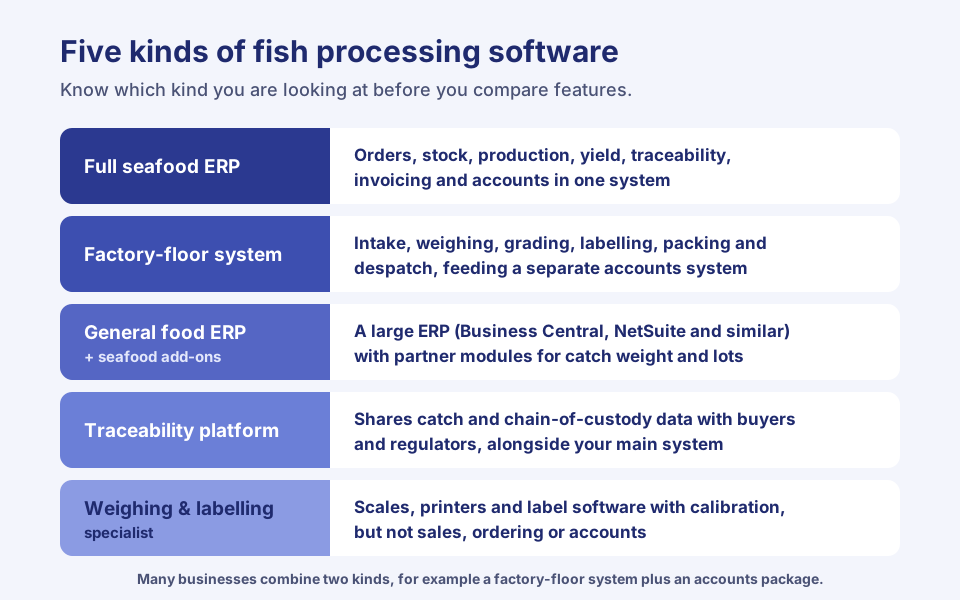
The five kinds of fish processing software
| Kind of system | What it usually covers | Worth considering if… |
|---|---|---|
| Full seafood ERP | Orders, stock, production, yield, traceability, invoicing and accounts in one system | You want one system to run the whole business |
| Factory-floor system | Intake, weighing, grading, labelling, packing and despatch; sends data to a separate accounts or ERP system | You already have an ERP you are happy with |
| General food ERP with seafood add-ons | A large ERP (Business Central, NetSuite and similar) with partner modules for catch weight and lots | You are a larger group already standardised on that ERP |
| Traceability platform | Sharing catch and chain-of-custody data with buyers and regulators | Your customers demand standards-based data exchange (for example GDST) |
| Weighing and labelling specialist | Scales, printers and labelling software, with calibration | You mainly need compliant weighing and labels, not sales or accounts |
Twelve questions to ask every supplier
- Is it built for fish, or adapted from meat or general food? Catch data, grading and species rules are hard to add later.
- Where is the catch and lot data captured, and by whom? Ideally at intake, once, and never re-keyed.
- Does it print UK labels, including catch area, gear category and production method, from the same data?
- Do weights come straight from the scales? Handwritten weights are where errors and giveaway start.
- Who supplies and supports the scales, printers and scanners? One supplier for hardware and software means one phone call when a label station stops.
- Will the hardware survive washdowns? Ask about stainless enclosures and ingress protection ratings.
- How fast can it trace a lot, forwards and backwards? Ask for a live demonstration with a real lot.
- Which accounting packages does it link to? For most UK firms that means Xero, Sage or QuickBooks.
- How do customer orders get in? Phone and email, an ordering app, EDI from supermarkets, or all of these?
- Can you start small and add modules (filleting, packing, despatch) as you grow?
- Where is support based, and during what hours? Fish businesses start early.
- Who else like you uses it? Ask for a UK customer of a similar size to call.
How the main names compare
The table below uses only what each supplier says on its own website (September 2026). Where a site does not mention something, that does not mean the product lacks it, so ask.
| Supplier | Kind of system | What its own site highlights | Worth asking about for the UK |
|---|---|---|---|
| Emydex (Ireland, BAADER group) | Factory-floor system | Describes itself as the market-leading factory-floor software supplier to fish processors in Ireland and the UK; grading, yield, landing and boat weigh-labelling | How it links to your accounts system |
| SI from Aptean / Aptean Food & Beverage ERP | Factory system / food ERP on Business Central | Catch-to-despatch traceability, trawler catch payments, intake and stock control; named UK fish customers; the ERP offers catch weight and scale integration | Which of the two products fits your size |
| JBT Marel (Innova, now AXIN Software) | Factory-floor system | Yield, packing and labelling, despatch scanning, closely tied to Marel equipment | Fit if you don't run Marel lines |
| Maritech (Norway, CAI Software) | Full seafood ERP | Cloud on Microsoft Azure, landing and catch certificates, yield, packing and labelling, vision-based quality checks | UK labelling fields and UK support |
| NOUVEM (Ireland) | Factory system | Weighing and labelling, traceability, sales and purchases; integrates with your ERP or accounts package | Catch-data fields |
| CSB-System (Germany) | Food ERP | Traceability and proof of origin, quality assurance and production for fish businesses; UK and Ireland team | Fish-specific depth for smaller firms |
| Foods Connected (Northern Ireland) | Supply-chain and compliance platform | Supplier compliance, specifications and traceability, including GDST data standards | It complements factory software rather than replacing it |
| inecta (USA) | Seafood ERP on Business Central | Vessel, catch location and grade at offloading, catch weight, yield; compliance content written around US rules (SIMP, FSMA 204) | UK labelling rules and UK support |
Traceability platforms such as Trace Register and ThisFish's Tally are listed by GDST as verified GDST-capable solutions. They are usually used alongside an ERP, not instead of one.
Where does Aquarius Pro fit?
Aquarius Pro, from ACSS, is a full factory system built only for UK fish and seafood processors, merchants and wholesalers. The core module covers customers, stock, sales orders, factory processing, invoicing and reports. Modules for purchase orders and goods in, filleting, supermarket packing, scallops, scanner despatch, hand grading and EDI can be added as you grow. ACSS supplies the weighing, labelling and scanning hardware as well as the software. Aquarius links to Xero, Sage and QuickBooks, and customers can order through Hooked, our own ordering app, or through Fresho, Orderlion, Choco and Shopify. See how the Aquarius system works and how the labelling works.
Where it is not the obvious choice: if you run large, highly automated lines built on Marel equipment, Marel's own software is the natural fit. If you mainly export and trade across many markets, a trade-focused ERP such as Maritech may suit better. And if your group already runs Microsoft Business Central, a seafood add-on for it is worth a look.
Quick answers
What's the difference between an ERP and factory-floor software? An ERP runs the whole business, including orders, stock and accounts. Factory-floor software runs weighing, labelling, packing and despatch, and passes the data to a separate accounts or ERP system.
Do I need GDST? Only if your buyers ask for data in that format. The legal minimum in the UK is the traceability information in the MMO guidance above.
Should the same company supply the scales and the software? It isn't essential, but it avoids the common problem of each supplier blaming the other when a label station fails.
What should I ask to see in a demo? A lot traced backwards and forwards, a label printed from a real weight, and an order going from entry to invoice.
Can I keep my accounting package? Usually. Ask exactly what is sent to it and how often.
Sources
- Traceability and labelling information for fisheries products (GOV.UK / Marine Management Organisation)
- Fish labelling and supply chain traceability (Seafish)
- The Fish Labelling Regulations 2013 (legislation.gov.uk)
- Verified GDST-capable solutions (Global Dialogue on Seafood Traceability)
- Supplier websites, September 2026: Emydex, SI from Aptean, Aptean Food & Beverage ERP, JBT Marel and AXIN Software, Maritech and Maritech Eye, NOUVEM, CSB-System and its UK team, Foods Connected, inecta
This is a practical summary, not legal advice. Supplier details are taken from their own websites in September 2026 and may change; check the latest with each supplier.