
Diesen Beitrag auf Deutsch lesen →
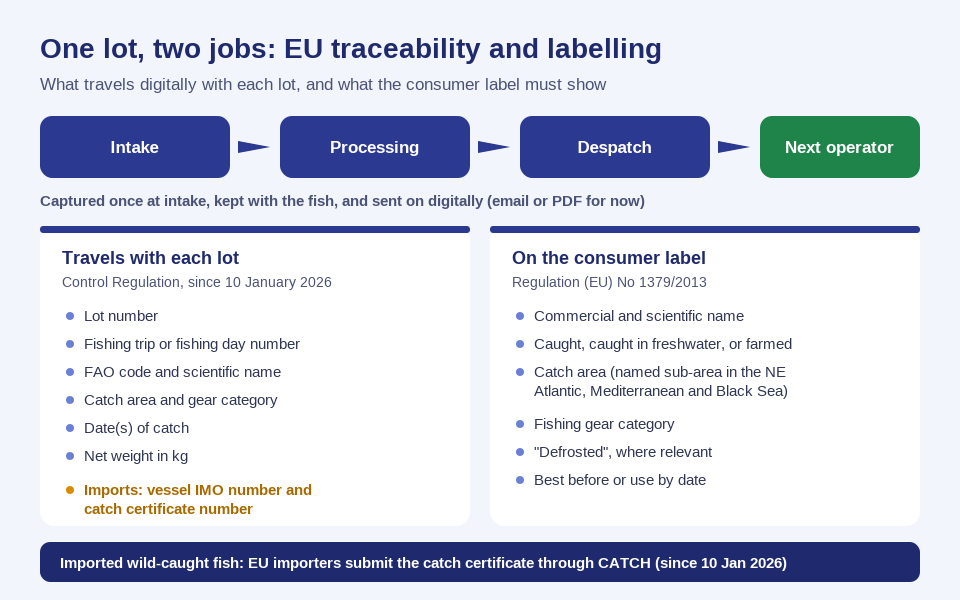
The short answer: three sets of EU rules decide what a fish processor has to record and print. Regulation (EU) No 1379/2013 sets what the consumer label must show: the commercial and scientific name, the production method, the catch area, the fishing gear category and whether the fish has been defrosted. Since 10 January 2026, the revised fisheries Control Regulation has required every operator to record the traceability information for each lot of fresh and frozen fish and seafood and pass it on digitally to the next operator. On the same date, the EU's CATCH system became compulsory for importers submitting catch certificates. Your software has to capture all of this once, at intake, and keep it attached to the fish until it leaves.
Which EU rules apply to a fish processor?
There are three, and they do different jobs:
| Rule | What it covers | Since |
|---|---|---|
| Regulation (EU) No 1379/2013, Chapter IV | What the consumer must be told about fishery and aquaculture products | 13 December 2014 |
| The fisheries Control Regulation, as revised by Regulation (EU) 2023/2842 | Lot traceability from catch or harvest to retail, now digital | 10 January 2026 for most provisions |
| The IUU Regulation (EC) No 1005/2008, as amended by the same 2023/2842 | Catch certificates for imported fishery products, submitted through CATCH | CATCH compulsory for EU importers from 10 January 2026 |
General food law sits on top of these. Prepacked fish must also carry what the EU's food information rules require of any food, such as the ingredients, net quantity, storage conditions, the name of the business, and a "best before" or "use by" date.
What must the consumer label show under 1379/2013?
The European Commission's pocket guide to these rules lists the mandatory information for unprocessed and some processed fish and seafood, such as salted or smoked fish and cooked shrimps in their shells, whether prepacked or not:
- Commercial designation and scientific name. The names must match the official list that each EU country publishes, so a French label uses the names on France's list and a Spanish label the names on Spain's.
- Production method: "caught", "caught in freshwater" or "farmed".
- Catch area. For sea fish, the FAO area. Fish from the Northeast Atlantic, the Mediterranean and the Black Sea must show the sub-area or division, with a name a consumer can understand (or a map or pictogram). Freshwater fish show the body of water and the country. Farmed fish show the country of production.
- Fishing gear category for wild fish, one of: seines, trawls, gillnets and similar nets, surrounding nets and lift nets, hooks and lines, dredges, and pots and traps.
- Defrosted, where the product has been frozen and thawed, with exceptions such as fish thawed before smoking, salting or cooking, or used as an ingredient.
- The "best before" or "use by" date.
Two details trip up software. Mixed batches of the same species from different areas or gear types must show the most representative area and say the products come from different areas, and the gear category for each batch. And for unprocessed frozen products that are prepacked, the label needs the date of freezing, written as "Frozen on" with the day, month and year.
What changed for lot traceability on 10 January 2026?
The revised Control Regulation entered into force on 9 January 2024, and most of its provisions have applied since 10 January 2026. For traceability, the European Commission sums up the change as mandatory digital traceability along the supply chain for fresh and frozen fishery and aquaculture products, including imports.
In practice, Ireland's Sea-Fisheries Protection Authority (SFPA) explains that operators at every stage of production, processing and distribution must keep the lot information on record and make it available digitally to the next operator, and to the authorities on request. For now, that can be done by email, a PDF, or scanned or photographed labels or commercial documents, if the two operators agree. France's fisheries ministry gives the same practical answer: until detailed standards are set, an email from one operator to the next, with the information in the message or an attached PDF.
None of this replaces the label. The SFPA is explicit that existing obligations to give traceability information on labels or accompanying documents still apply.
What information has to travel with each lot?
The list is in the revised Article 58(5) of the Control Regulation. As set out by France's fisheries ministry:
| Information | Notes |
|---|---|
| Lot identification number | The number you give the lot, which follows it to your customer |
| Fishing trip or fishing day | The unique fishing trip or fishing day number(s); for aquaculture, the producer or production unit |
| For imports instead | The vessel's IMO number or other unique identifier and, where relevant, the catch certificate number |
| FAO alpha-3 code and scientific name | For example COD and Gadus morhua |
| Geographical area | Where it was caught at sea, or the catch or production area for freshwater and farmed fish |
| Fishing gear category | For wild-caught fish |
| Date(s) of catch or harvest | One or more dates |
| Quantity | Net weight in kilograms, or number of individuals |
| Undersized fish | Quantities below the minimum conservation reference size, shown separately |
| Marketing standards | Any information those standards require |
If you buy at first sale, there is more: the SFPA notes that sales notes must now be submitted electronically within 48 hours of the first sale, whatever the buyer's turnover.
When do processed and canned products come in?
Not yet. The Commission says digital traceability will be "gradually expanded" to processed products such as canned fish. Its timetable puts traceability for prepared and preserved fishery and aquaculture products, and algae, from 10 January 2029, and the European Parliament's summary of the law says it will apply once the Commission has finished a study of the available solutions. If you make canned, marinated or ready-to-eat products, keep an eye on that study.
What is CATCH, and does it affect you?
CATCH is the EU's online system for catch certificates, part of the TRACES NT platform. According to the Commission's own questions and answers, since 10 January 2026 EU importers have had to submit catch certificates and related documents, such as processing statements, through CATCH. Exporters outside the EU, including UK exporters, can use CATCH directly on a voluntary basis. If they send paper instead, the EU importer has to type the data into CATCH and upload a scan, and the Commission warns that paper certificates mean longer import procedures.
So if you import wild-caught fish into the EU, your records need the catch certificate number against each lot, which is also on the Article 58 list for imports. If you export from the UK to the EU, our earlier guide on what changed on UK catch certificates in 2026 covers your side of it.
What must your software record?
Put the three sets of rules together and a processing system needs to do six things:
- Capture everything at intake. Lot number, trip or day number (or IMO number and catch certificate number for imports), species, FAO code, area, gear, catch dates and net weight, ideally imported from the supplier's data rather than retyped.
- Keep it attached through processing. When you fillet, grade or repack, each new box has to carry the information of the lot it came from.
- Print both forms of the catch area. The sub-area in words a consumer understands on prepacked fish, and the same data in the form your trade customers expect.
- Use the right names for each country. The commercial designation comes from the official list of the country where the fish is sold, which matters if you sell into more than one.
- Pass the lot information on digitally. Today by email or PDF; later in whatever format the detailed standards set. Ask your supplier how the system will follow that change.
- Find any lot quickly. Where it came from and where it went, when an inspector or a customer asks.
How Aquarius helps
Aquarius records the vessel, catch date and catch area for each lot at goods in, and prints barcoded labels with the species, catch area, FAO code, lot number and use-by date. Scanning a label brings up the lot's traceability record, and labels for export customers can be printed in their language. The software is available in 15 languages, and we supply and support it across Western Europe. If you want to check it against the list above with your own species and labels, get in touch.
Quick answers
Is an email really enough to pass on traceability information? For now, yes, if both operators agree. The SFPA and France's fisheries ministry both accept email or PDF until the EU sets detailed standards.
Do the new traceability rules cover smoked salmon or canned tuna? Not the digital lot rules yet. They apply to fresh and frozen products now, and the Commission's timetable puts prepared and preserved products from 10 January 2029, after a study.
Does the gear category have to be on the consumer label? Yes, for wild-caught fish, using one of the seven categories in Regulation 1379/2013.
Do non-EU exporters have to use CATCH? No. It is compulsory for EU importers. Exporters outside the EU may use it voluntarily, and the Commission encourages them to.
Sources
- A pocket guide to the EU's new fish and aquaculture consumer labels (European Commission)
- Regulation (EU) No 1379/2013, common organisation of the markets in fishery and aquaculture products (EUR-Lex)
- Regulation (EU) 2023/2842, amending the fisheries Control Regulation and the IUU Regulation (EUR-Lex)
- Control regulation (European Commission, Oceans and fisheries)
- The EU fisheries control system gets a major revamp (European Commission, EU Blue Economy Observatory)
- What is new in the EU catch certification scheme: frequently asked questions (European Commission, December 2025)
- Revision of the fisheries control system (European Parliament Legislative Train)
- SFPA issues guidance on new EU fisheries control rules effective January 2026 (Sea-Fisheries Protection Authority, Ireland)
- Traçabilité des produits de la pêche et de la mer (French Ministry for the Sea)
This is a practical summary, not legal advice. The detailed EU standards for digital traceability are still being set: check the current rules with your national fisheries authority before relying on it.